DPD Ireland Shipping Integration for WooCommerce, Shopify and Custom Stores
I connect Irish online stores directly to DPD Ireland, so orders become booked consignments, printed labels and customer tracking links without anyone re-typing an address. Fixed quote, code you own, no monthly fee to a middleman.
From DPD credentials to first parcel
Recurring cost to the client
Automated test assertions
Figures from the Sacks.ie DPD Ireland integration.
Stop re-typing orders into DPD’s portal
If your team copies each customer’s address from WooCommerce or Shopify into DPD Ireland’s web portal, prints one label, then pastes a tracking number back into the order, you’re paying for that process on every parcel. It’s slow, and every manual step is a chance to misspell an Eircode, swap a house number or forget to send tracking.
Most shipping plugins don’t solve this for Irish stores. The popular WooCommerce DPD plugins are built for DPD UK and DPD Local, which run on a different system from DPD Ireland’s API. Multi-carrier shipping apps can work, but they add a monthly subscription and another dashboard between your shop and your courier.
A direct integration removes the middle step. Your store talks to DPD Ireland itself.
DPD Ireland integration for WooCommerce
For WooCommerce stores I build a self-contained plugin that connects your shop to your own DPD Ireland account. On the Sacks.ie project, that meant:
- One-click labels from the order screen, with parcel count and weight prefilled from the order
- Bulk label creation and printing: select a day’s orders, book every consignment, and print them all as one job
- A label icon on the orders list showing the consignment number, so you can reprint without opening the order
- Automatic booking on a chosen order status (for example “Processing”), run in the background so checkout is never slowed down
- Tracking links for customers, on the order and in WooCommerce’s notification emails
- A clear test/live switch, so nobody books a real consignment by accident
Every build is shaped around your workflow. If you only need bulk printing, or you want booking triggered by your own fulfilment step, the plugin does just that.
DPD Ireland integration for Shopify
For Shopify stores, the integration runs as a custom app connected to your store through Shopify’s Admin API. It picks up orders ready to ship, books the consignment with DPD Ireland, retrieves the label, and writes the tracking number back to the Shopify order, so the customer’s shipping confirmation includes it.
Before building anything, I’ll check whether an existing Shopify shipping app already covers your needs at a sensible price. If one does, I’ll tell you and help you set it up properly. A custom app makes sense when you need:
- No per-label or monthly subscription fees
- A workflow the apps don’t support (custom parcel rules, split shipments, B2B accounts)
- Correct handling of Northern Ireland and other edge cases
- Data that stays between your store and DPD
Custom DPD Ireland API integration for other platforms
Not on WooCommerce or Shopify? DPD Ireland’s API is compact: authorise, create a consignment, track. That means it can be connected to most systems that can make a secure web request, including custom-built shops, order management systems and back-office tools.
Tell me what you run and how orders flow today, and I’ll tell you plainly whether a direct integration is practical.
What the integration automates
| Manual today | Automated after integration |
|---|---|
| Copying each address into DPD’s portal | Consignment booked from the order data |
| Printing labels one at a time | A whole batch printed as one PDF job |
| Pasting tracking numbers back into orders | Tracking number saved to the order automatically |
| Emailing customers their tracking | Tracking link included in your store’s own emails |
| Looking up which parcel went where | Consignment number visible on the order list |
How much time will it save? That depends on your order volume and how your team packs today, so I won’t quote a number I can’t back up. A useful way to estimate: time how long one manual DPD booking takes your team, multiply by your daily parcel count, and that’s roughly the work a direct integration removes. With bulk printing, what’s left is selecting the orders and pressing one button.
Northern Ireland and the details that break integrations
Shipping integrations rarely fail on the happy path. They fail on details that quietly produce wrong results months later. Some I’ve already solved:
- Northern Ireland isn’t “the UK” for customs. WooCommerce sends NI addresses with a GB country code. Treat GB as “UK, needs a customs declaration” and you’ll mishandle a large share of orders. Under the Windsor Framework, goods from Ireland to Northern Ireland stay within the EU customs area, so the integration classifies destinations by postcode as well as country. I verified this against DPD’s live routing, not just the documentation.
- A rejected shipment can look like a success. DPD Ireland’s API can return a normal “OK” response while rejecting an individual consignment, and the rejected record can still carry a tracking number. My integrations check the overall status, then the consignment-level error, and only then trust the tracking number.
- Special characters can silently delete data. A business name like “Caffè & Sons Ltd” once produced an empty field with no error. Tests built from awkward real-world input catch this before it reaches a label.
- Label format should follow your printer. ZPL suits network-connected thermal printers. A USB Zebra printer on one PC usually works better with PDF labels sent through the normal printer driver. I match the output to the hardware you actually have.
- Security. DPD credentials stay out of the database in configuration constants, logs are scrubbed of credentials and session tokens, and label download URLs are validated before they’re fetched.
Already have a DPD integration that isn’t working?
If you have a plugin or app that’s failing to book consignments, printing blank labels, recording failed shipments as booked, or treating Northern Ireland orders as GB exports, I can diagnose and fix it, or replace it if it’s beyond repair.
Common things I check:
- API credentials and the test vs live environment settings
- Error responses being ignored (see “a rejected shipment can look like a success” above)
- Address mapping: Eircodes, county fields, NI postcodes, business names
- Label retrieval and printer format
- Background tasks (WP-Cron or webhooks) that stopped running
Case study: Sacks.ie
Sacks Online Ltd ship bulk bags and sandbags nationwide from Ireland. Before the integration, every parcel meant re-typing the customer’s address into DPD’s portal and printing labels one at a time. No WooCommerce plugin on the market supported DPD Ireland, and the only off-the-shelf route was paid middleware.
I built a custom WooCommerce plugin connecting their store directly to DPD Ireland. The warehouse now selects a day’s orders, presses one button and prints every label as a single job. Tracking numbers are recorded automatically, and there’s no monthly fee between the shop and the courier.
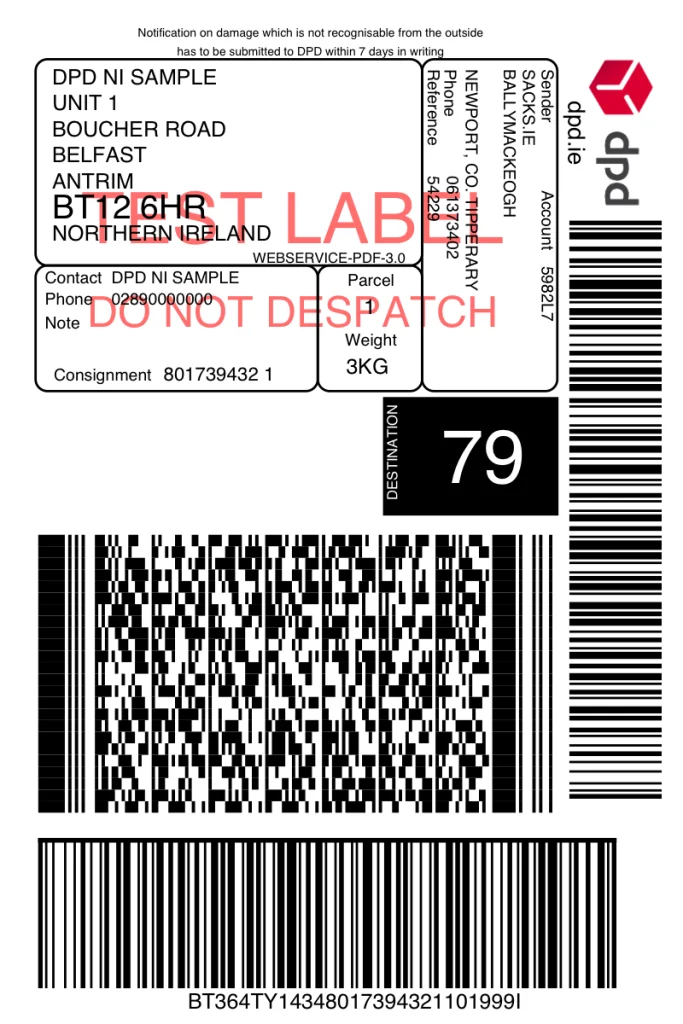
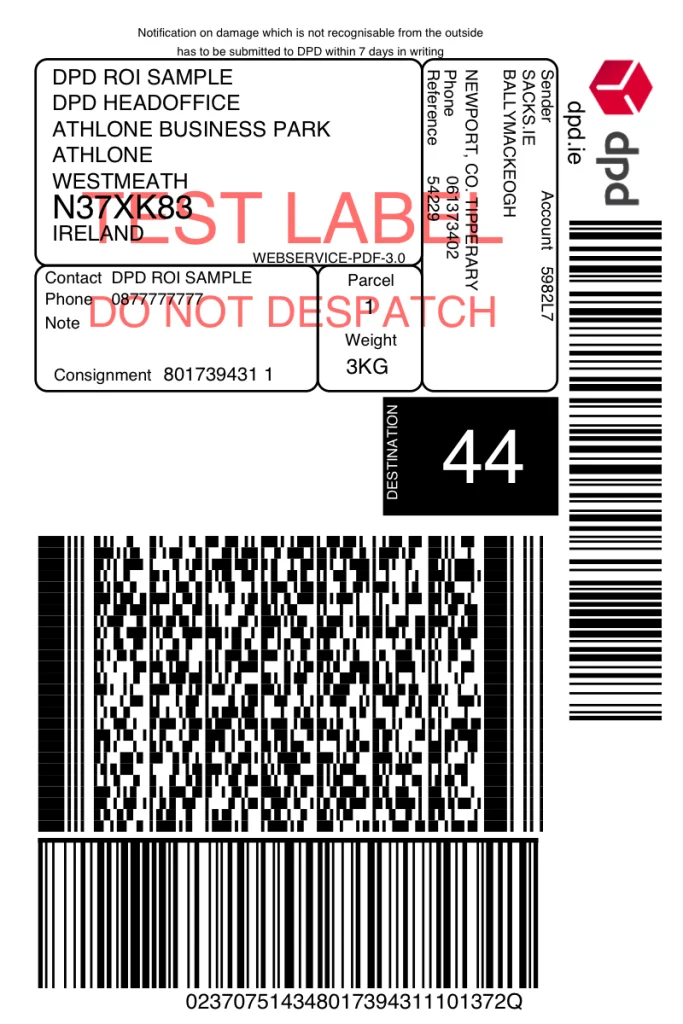
Read the full Sacks.ie DPD Ireland case study, including how the integration was tested against DPD’s pre-production environment.
Also for Sacks.ie: an Eircode address autofill for WooCommerce checkout that cuts form fields and delivery errors.
Custom integration or an off-the-shelf shipping app?
Honest answer: it depends.
An off-the-shelf app is often better if you ship low volumes, use several couriers and want one dashboard, or you’re happy paying a monthly fee for a hosted tool.
A custom DPD Ireland integration is often better if DPD is your main courier, you ship enough parcels that subscription or per-label fees add up, you’re on WooCommerce (where DPD Ireland-specific plugins are hard to find), or you need workflow details, such as Northern Ireland routing, bulk printing or B2B rules, that the apps don’t handle.
If an existing tool fits your store, I’ll say so on our first call.
How it works: from first call to first parcel
- Free scoping call (about 30 minutes). We go through your platform, order volume, printers and how you pack and ship today.
- Fixed quote. You get a written scope and a fixed price before any work starts.
- DPD API access. You request API access for your DPD Ireland business account. DPD issues API credentials linked to your account, and I’ll tell you exactly what to ask for.
- Build and test in DPD’s pre-production environment. Nothing is sent to real customers and no real consignments are created while we test.
- DPD approval and go-live. DPD reviews test shipments before enabling live shipping. Once approved, we switch to live and ship your first real parcel together.
- Handover. You own the code outright, with no licence or subscription fee from me.
Frequently asked questions
Do I need a DPD Ireland business account?
Yes. API access is tied to a DPD Ireland account, and postage is billed by DPD directly to you as it is today. The integration doesn't change your DPD rates.
Is there a ready-made DPD Ireland plugin for WooCommerce?
When I researched this for Sacks.ie, the WooCommerce shipping plugins on the market targeted DPD UK and DPD Netherlands, which use different systems from DPD Ireland. Multi-carrier platforms are the main off-the-shelf alternative, usually with a subscription. If a ready-made option fits your setup, I'll point you to it.
Will a DPD UK plugin work with my DPD Ireland account?
Generally no. DPD UK and DPD Local run on a separate platform and API from DPD Ireland, so their plugins expect different credentials and endpoints.
How long does a DPD Ireland integration take?
For Sacks.ie, it took 3 days from receiving DPD's API credentials to shipping the first parcel. Your timeline depends on scope and on how quickly DPD issues credentials and approves go-live, which is outside either of our control.
How much does it cost?
It depends on your platform and the features you need, so every project gets a fixed quote after a free scoping call. There's no monthly fee from me for the integration itself.
Can you handle shipments to Northern Ireland correctly?
Yes. Northern Ireland addresses are classified by postcode as well as country, so they aren't treated as GB exports. This was verified against DPD's live routing on the Sacks.ie project.
Will it work with my label printer?
Most likely. DPD labels are available as PDF, which prints through a normal printer driver, and ZPL is an option for compatible thermal printers. Tell me your printer model and how it's connected.
Can you integrate DPD Ireland with Shopify?
Yes, through a custom app using Shopify's Admin API, or by helping you set up a suitable existing app if that's the better value.
What if my platform isn't WooCommerce or Shopify?
If your system can make secure web requests (most modern platforms and custom builds can), a direct integration is usually possible. Tell me what you use.
Do you work with businesses across Ireland?
Yes. I work remotely with businesses across Ireland, including Northern Ireland.
Get a quote for your DPD Ireland integration
Tell me which platform you use, roughly how many parcels you ship a day, and what's slowing your dispatch down. I'll reply with honest advice and, if a custom integration makes sense, a fixed quote.